INDUSTRIAL SMART WATER & IoT AUTOMATION
1. Introduction: The Rising Imperative for Industrial Water Efficiency
Water is the lifeblood of industrial operations—from textile dyeing, chemical processing, and pharmaceuticals to food processing and thermal power generation. However, industrial facilities face a dual challenge: skyrocketing freshwater acquisition costs and increasingly stringent discharge norms mandated by State and Central Pollution Control Boards (SPCBs/CPCB).
Traditional, manually operated Effluent Treatment Plants (ETP) and Sewage Treatment Plants (STP) are no longer sufficient. Manual sampling is prone to human error, chemical dosing is often imprecise, and delayed equipment maintenance leads to catastrophic plant downtime and costly regulatory penalties.
2. The Pillars of Industry 4.0 Smart Water Management
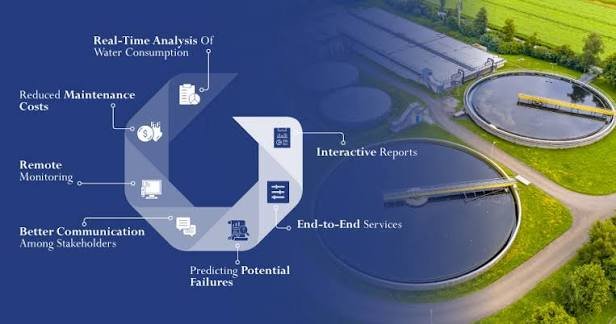
To achieve operational efficiency and compliance, modern industrial facilities are adopting a connected, automated water stack.
[IoT Telemetry & Sensors] ──► [PLC/SCADA Automation] ──► [AI Analytics & NEMS Dashboard]
A. Real-Time IoT Telemetry & Industrial Sensors
Industrial IoT sensors placed across raw water inlets, filtration stages, and discharge outlets continually capture critical chemical and physical metrics:
TDS & Electrical Conductivity (EC): Tracks dissolved solids across membrane filtration stages.
pH & ORP (Oxidation-Reduction Potential): Guarantees accurate neutralization and oxidation reactions.
Turbidity & Flow Telemetry: Detects fouling in filtration beds and monitors instantaneous volumetric flow rates.
B. Automated PLC & SCADA Process Controls
Programmable Logic Controllers (PLCs) combined with Supervisory Control and Data Acquisition (SCADA) systems automate complex treatment sequences without human intervention:
Automated Dosing Controls: Adjusts coagulant, flocculant, and acid/alkali dosing pumps based on real-time sensor feedback, reducing chemical consumption by up to 30%.
Self-Cleaning & Backwash Sequences: Triggers automatic backwashing of sand filters, carbon filters, and membrane flushing cycles when differential pressure reaches set thresholds.
C. AI-Powered Predictive Maintenance
Unexpected pump failures or membrane fouling in Zero Liquid Discharge (ZLD) systems can stall entire production lines. Machine learning algorithms analyze historical pressure gradients, vibration patterns, and flow degradation curves to:
Predict membrane fouling days before clogging occurs.
Alert maintenance engineers to service high-pressure RO pumps prior to mechanical failure.
Extend overall capital equipment lifespan by operating machines strictly within optimal efficiency envelopes.
3. Zero Liquid Discharge (ZLD) & Environmental Auditing (NEMS)
Achieving true Zero Liquid Discharge involves high-recovery Reverse Osmosis, Thermal Evaporators, and Crystallizers. Operating these units requires precise energy and mass balance tracking.
Integrated Nandtech Environmental Management Systems (NEMS) provide industrial managers with a single dashboard that displays:
Water Footprint Audits: Total freshwater intake vs. recycled volume vs. final sludge output.
Energy Intensity Tracking: Kilowatt-hours (kWh) consumed per cubic meter ($m^3$) of water treated.
Automated Regulatory Compliance: Continuous live data streaming directly to pollution control board servers, providing tamper-proof digital proof of compliance.
4. Conclusion: Upgrading Your Industrial Water Infrastructure
In the era of Industry 4.0, treating industrial water as an unmonitored utility is a major financial risk. By integrating Nandtech Group’s Core Technology Stack (IoT, SCADA, Automation & AI Analytics), industrial plants can cut operating costs, reduce energy consumption, and guarantee 100% regulatory compliance.